Full Convert is designed for ease of use and reliability to make sure you get your job done as quickly and as simply as possible.
CSV is also known as
TSV, Flat file, Comma-separated text, TAB-separated text
(: csv, tsv, txt).
Making migration easy for you
Full Convert is a fully self-tuning software. Your migration will work as expected without you needing to adjust anything.
Data types are different in CSV compared to Oracle RDB. We automatically adjust them as we copy the tables so you don't have to worry about it. You can adjust the mapping rules if you wish to change the following defaults: watercad v8i tutorial pdf
binary_double
double
binary_float
double
char
ntext
clob
ntext
date
datetime
float
double
long
ntext
long raw
blob
nchar
ntext
nclob
ntext
number
double
nvarchar2
ntext
raw
blob
rowid
integer
sdo_geometry
ntext
timestamp
datetime
urowid
integer
varchar2
ntext
xmltype
ntext
WaterCAD V8i offers several ways to present model results, ranging from automated summaries to highly customizable data sets.
Since WaterCAD V8i is an older version (superseded by WaterGEMS/WaterCAD CONNECT Edition), official PDFs are often moved to archive servers or are harder to find. This guide will help you locate the official documentation and outline the standard workflow you will learn in those tutorials.
| Section | Description | |---------|-------------| | | Overview of WaterCAD V8i, system requirements, and installation notes. | | 2. Getting Started | Launching the software, understanding the ribbon interface, and setting up project preferences. | | 3. Building a Network | Creating pipes, junctions, reservoirs, tanks, and pumps. Importing data from AutoCAD or GIS. | | 4. Entering Demands | Assigning base demands, demand patterns (hourly/daily), and demand alternatives. | | 5. Running a Hydraulic Analysis | Setting up a steady-state or EPS (Extended Period Simulation) run. | | 6. Viewing Results | Interpreting color-coded maps, tables, profiles, and contour plots. | | 7. Fire Flow Analysis | Performing fire flow simulations and verifying ISO requirements. | | 8. Water Quality Modeling | Simulating chlorine decay, water age, and source tracing. | | 9. Scenario Management | Using alternatives and scenarios to compare “what-if” designs. | | 10. Reporting & Exporting | Generating custom reports and exporting results to Excel or Shapefiles. |
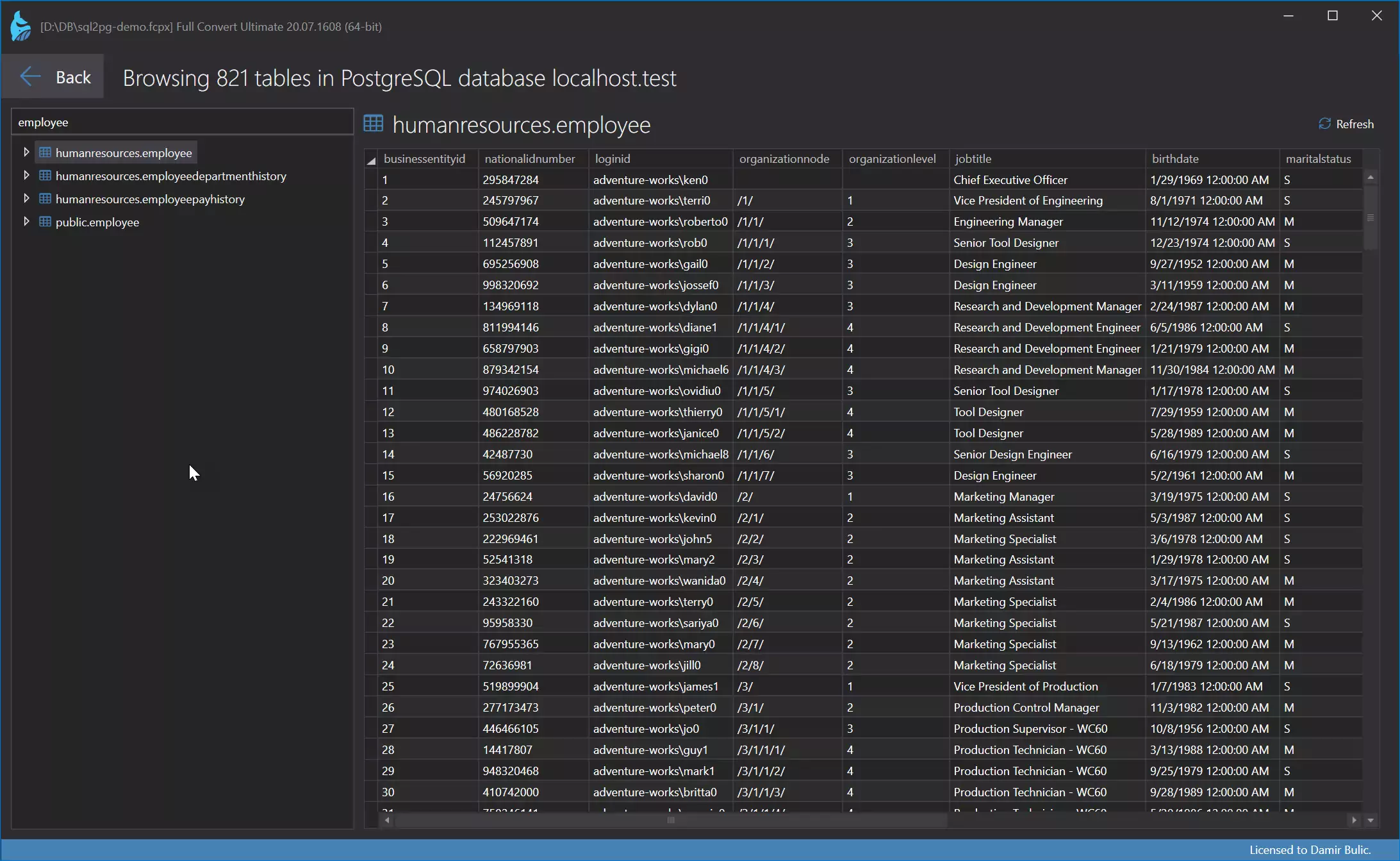
Data is now in the target database
Use our built-in database browser to examine the copied data.
Of course, you can also examine the conversion in detail and see in-depth information for each table.
Migrate your data now.
60-day money back guarantee
Full Convert is used by thousands of organizations in 98 countries.
WaterCAD V8i offers several ways to present model results, ranging from automated summaries to highly customizable data sets.
Since WaterCAD V8i is an older version (superseded by WaterGEMS/WaterCAD CONNECT Edition), official PDFs are often moved to archive servers or are harder to find. This guide will help you locate the official documentation and outline the standard workflow you will learn in those tutorials.
| Section | Description | |---------|-------------| | | Overview of WaterCAD V8i, system requirements, and installation notes. | | 2. Getting Started | Launching the software, understanding the ribbon interface, and setting up project preferences. | | 3. Building a Network | Creating pipes, junctions, reservoirs, tanks, and pumps. Importing data from AutoCAD or GIS. | | 4. Entering Demands | Assigning base demands, demand patterns (hourly/daily), and demand alternatives. | | 5. Running a Hydraulic Analysis | Setting up a steady-state or EPS (Extended Period Simulation) run. | | 6. Viewing Results | Interpreting color-coded maps, tables, profiles, and contour plots. | | 7. Fire Flow Analysis | Performing fire flow simulations and verifying ISO requirements. | | 8. Water Quality Modeling | Simulating chlorine decay, water age, and source tracing. | | 9. Scenario Management | Using alternatives and scenarios to compare “what-if” designs. | | 10. Reporting & Exporting | Generating custom reports and exporting results to Excel or Shapefiles. |